Privacy regulations
Please read carefully the privacy policy of the Brussels Health Network, an initiative of the care providers united under the aegis of the non-profit Association Bruxelloise de Télématique Médicale (Abrumet asbl) [Brussels Association of Medical Telematics]. It governs the terms and conditions of use of the computerized medical data sharing network.
Changes made on july 13, 2026
5. Data hosting : “The vault also contains vaccination records (Vaccicard), as provided for in Article 20 of the Ordinance of 16 May 2024 on health prevention policy.[1] The Brussels Health Network acts as a processor within the meaning of Article 4(8) of the GDPR, and the healthcareproviders acts as the controller within the meaning of Article 4(7) of the GDPR.”
1. Some definitions
- The Brussels Health Network: the medical data-sharing network managed by the Brussels Association for Medical Telematics (asbl Abrumet). It is a Hub of the (federal) e-health platform. The names Brussels Health Network or Abrumet are used interchangeably in this document.
- Care provider: healthcare providers and healthcare institutions referred to in Article 2, 3° of the Ordinance on the electronic health data exchange platform.
- Care-related relationship: link established between a care provider and a patient1.
- Data: personal data within the meaning of Article 4(1) of the GDPR.
- Data safe: a service for hosting the details of health providers without an appropriate IT infrastructure, in the aim of enabling them to participate in the health data-sharing system stated in article 5, §1, 3° of the decree relative to the electronic platform for exchanging health data.
- EPR or electronic patient record: computerized medium containing all electronic health data relating to the patient regarding their care, the components of which are the medical record, the nursing care record, and the administrative record.
- GDPR: regulation 2016/679 from the European Parliament and the Council dated 27th April 2016 relative to the protection of natural persons regarding the processing of personal data and the free movement of such data, repealing directive 95/46/EC (General Data Protection Regulation) and the Belgian framework law.
- Healthcare providers: the care dispensers and care institutions stated in article 2, 3° of the decree relating to the electronic health data exchange platform.
- Health data: item of data processed in the context of the care dispensed, as stated in article 2, 2° of the decree relative to the platform for exchanging health data.
- Hub: regional entry point to the (federal) e-health platform for member service providers and care establishments.
- Legal representative: person designated pursuant to an applicable piece of legislation for the purpose of representing and defending the interests of the patient. The legal representative acts in the name of and on behalf of the patient.
- Medical profile: medical field in which the care provider works (surgery, general medicine, physiotherapy, etc.).
- Patient: the natural person defined in Article 2, 1° of the Law of 22 August 2002 on patient rights, or any person exercising their rights as a representative pursuant to that Law or any other applicable legislation.
- Patient Rights Act: Act of 22nd August 2002 relative to patient rights.
- Publication: viewing via the Brussels Health Network of an item of data, whether contained in an EPR or not.
- Therapeutic relationship : the care relationship entered into between a professional practitioner and a patient2.
- Unique identifier: unique sector-specific personal identification number in the health field stated in article 7, §3 of the decree relative to the platform for exchanging health data.
2. Introduction
These Privacy Regulations (hereinafter referred to by the French initials “RVP”) pertain to the networking of Brussels health actors through the Brussels Health Network.
When registering with the network, all professional users confirm that they have read and accepted the Conditions of Use and this Privacy Policy.
The object of the Brussels Health Network (hereinafter referred to as “BHN”), which Abrumet manages in accordance with the decree adopted at the Board meeting of 6 June 2019 creating the platform for the electronic exchange of health data between health actors under the purview of the COCOM [Common Community Commission], is “the automatic computerized transmission or online provision of any data or communication relating to health or administrative purposes by and between the various health actors, by means of the most appropriate systems of technology” (Article 4 of the Ordinance of 4 April 2019 on the electronic health data exchange platform). In other words, the RSB aims to facilitate the sharing of patient information for the continuity of care and to that end provides an organizational and technological framework at the cutting edge of security and standardization. Data are exchanged by and between health actors through this network in compliance with applicable legislation, medical ethics and patient privacy.
This is a long-term project. Given its cultural, organisational, technical and financial implications, it will be developed cautiously and gradually.
Its promoters and users will never lose sight of the fact that it is being developed in the exclusive interest of the patient, and that this takes precedence over all other considerations.
As a hub within the meaning of the Ordinance of 4 April 2019, the BHN provides a value-added service in the form of a central index of documents (protocols, labs, images, SUMEHR, etc.) that can be consulted in the hosting sites. The BHN is based on a decentralization of data which remain on the hosting sites and are accessible via the central index of documents.
Thanks to this network Healthcare providers who have a therapeutic or care relationship with a patient may access the shared computerized medical information concerning that patient, with the latter’s consent. The concept of a therapeutic or care relationship encompasses any healthcare actor involved in the continuity of a patient’s care, including specialists in medical analysis or medical imaging.
The Brussels Health Network is also a Hub within the (federal) e-Health platform system and is a subcontractor of the health providers in the sense of the GDPR in terms of the exchange of personal health data via the network.
The health actors remain responsible for the processing of patient data.
The Brussels Health Network is a subcontractor of the health actors within the meaning of the GDPR for the exchange of personal data relating to health via the network.
In its capacity of data processor, it acts both as a network and as a safe:
- As a network, it provides access to data that remain hosted in the connected hospital institutions.
- As a safe, it hosts securely the data of practitioners in private practice.
The Brussels Health Network is responsible for consistent processing and the creation of the unique patient identifier required for the exchange of health data within the network.
Since participation in the Brussels Health Network is voluntary, the Brussels Health Network can never guarantee the completeness of the patient’s data. The publication of the SumEHR (summarized electronic health record) by the healthcare provider is desirable, though not mandatory.
These regulations pertain to all use of the Brussels Health Network, whether via the DPI, the DMI, the portal or the mobile application.
3. Data Processed by Brussels Health Network
Abrumet retains the data required for the proper operation of the Brussels Health Network and which is used to validate requests for action, both from patients and from health providers.
This data consists of:
Data relating to patients:
- identification of patients,
- memorisation of their informed consent for sharing health data in the context of the continuity of care,
- the references to decentralised medical records,
- access logs,
Data about care providers and health providers:
- the identification of care providers,
- memorisation of their membership,
- references to decentralised medical data,
- access log,
- number of consultations per GP,
- number of SUMEHRs published per GP,
- number of patients registered per GP,
- number of SUMEHRs linked to the number of patients,
- e-mail address to be used for all communication in the event of a security breach
4. Subcontracting
4.1. Fratem (Réseau Santé Wallon)
In view of the expertise developed by the Regional Federation of Medical Telematics Associations, referred hereinafter as Fratem, in relation to the design and implementation of an electronic health data exchange platform, Abrumet has called on Fratem to:
- make the Hub, Data Safe and Portal developments of the Walloon Health Network available to Abrumet
- provide a second-level maintenance and support service for these developments
- make the hardware and software infrastructure available in order to host Abrumet’s Hub, Data Safe and Portal in the production, test and UAT environment
- coordinate the management of this infrastructure and the availability of specialist human resources to manage this infrastructure.
Fratem presents sufficient guarantees regarding the implementation of appropriate technical and organisational measures in a secure environment.
4.2. NSI
To enable health providers who do not have the material resources for hosting data relating to the health of their patients to share this health data, the Brussels Health Network makes a secure data ‘safe’ available to them.
To make this happen, we have subcontracted NSI, the company that manages our infrastructure.
NSI offers a whole range of guarantees regarding the implementation of appropriate technical and organisational measures in a secure environment.
4.3. Amaron
As part of the development of the new hub functionalities, Abrumet also calls upon the company Amaron.
Amaron provides sufficient guarantees to implement appropriate technical and organizational measures in a secure environment.
5. Data hosting
The central server of the Brussels Health Network contains only an index (hyperlinks) of health data per patient, which remain hosted within the institutions or in the secure vault referred to in Article 7 of the Ordinance of 4 April 2019 on the electronic platform for the exchange of health data.
The vault also contains vaccination records (Vaccicard), as provided for in Article 20 of the Ordinance of 16 May 2024 on health prevention policy. 3The Brussels Health Network acts as a processor within the meaning of Article 4(8) of the GDPR, and the healthcare providers acts as the controller within the meaning of Article 4(7) of the GDPR.
5.1. Data Retention Period
Abrumet ensures the retention of central data for a minimum period of 30 years and a maximum period of 32 years from the last transaction carried out regarding the patient, notwithstanding the latter’s potential death.
The Brussels Health Network refers each healthcare professional to their own data retention responsibilities for decentralized data for which they are the data controller; that is to say, the health documents which, as a reminder, are for the vast majority stored exclusively within the Electronic Medical Records of these professionals.
6. Management of access rights by the Brussels Health Network
6.1. Care providers
The aim is to define whether a care provider has permission (i.e. may or may not) carry out an action (e.g. to view) on an item of data for a specific patient, based on a particular context (attending physician or on-call doctor, for example).
For permission to be granted:
- The patient must have consented explicitly to the sharing of his/her data via the Brussels Health Network.
- A care provider must have declared the item of data to be relevant for an exchange.
- This declaration must not be accompanied by a general or specific exclusion of the care provider.
- The care provider in private practice must have explicitly agreed to these privacy regulations of the Brussels Health Network in order to register. For institutional care providers, each institution has undertaken to register only those who have accepted the privacy regulations of the Brussels Health Network.
- The care provider must have the right to carry out the action (view) for this type of data. Specific rights are required to enable different types of care provider to access different categories of health data. It should be remembered that these are “default” access rules and that there are also access variation mechanisms at the level of each document.
- The care provider must have declared a care-related or treatment relationship with the patient (attending physician or on-call doctor, for example). When a care professional refers his/her patient to another care professional, he/she may, with his patient’s informed consent or at his patient’s request, specify a therapeutic relationship between his patient and that third healthcare professional.
Restrictions : It is forbidden for any health provider to access health data via the Brussels Health Network for any purpose other than to ensure continuity of care, such as expert reports, insurance contracts, eligibility for reimbursement, etc…
The data will be anonymized or pseudonymized in the event that they are subject to analysis by or at the request of public or scientific bodies, and solely where a legal framework permits such an analysis or request or following authorization from Abrumet’s Board of Directors and the Data Protection Authority (DPA).
Furthermore, it is essential to remember that the Brussels Health Network does not aim to become the patient’s exhaustive health file. Moreover, it does not have the capacity to do so insofar as the participation of healthcare professionals is voluntary.
Only documents relevant to the continuity of care will be exchanged on the network.
The patient also has the right to choose which documents or professionals to exclude from the exchange.
This table of accesses corresponds to the minimum accesses established by the eHealth Platform. It may change as care providers are gradually integrated into the Brussels Health Network and as projects are developed with players in the field, subject to validation by Abrumet members (federations of GP associations and care institutions established in the Brussels-Capital Region). In order to simplify matters for users, the access matrix applied by the Réseau Santé Bruxellois follows in principle that established by the Réseau Santé Wallon.
Download the access matrix in excel format.
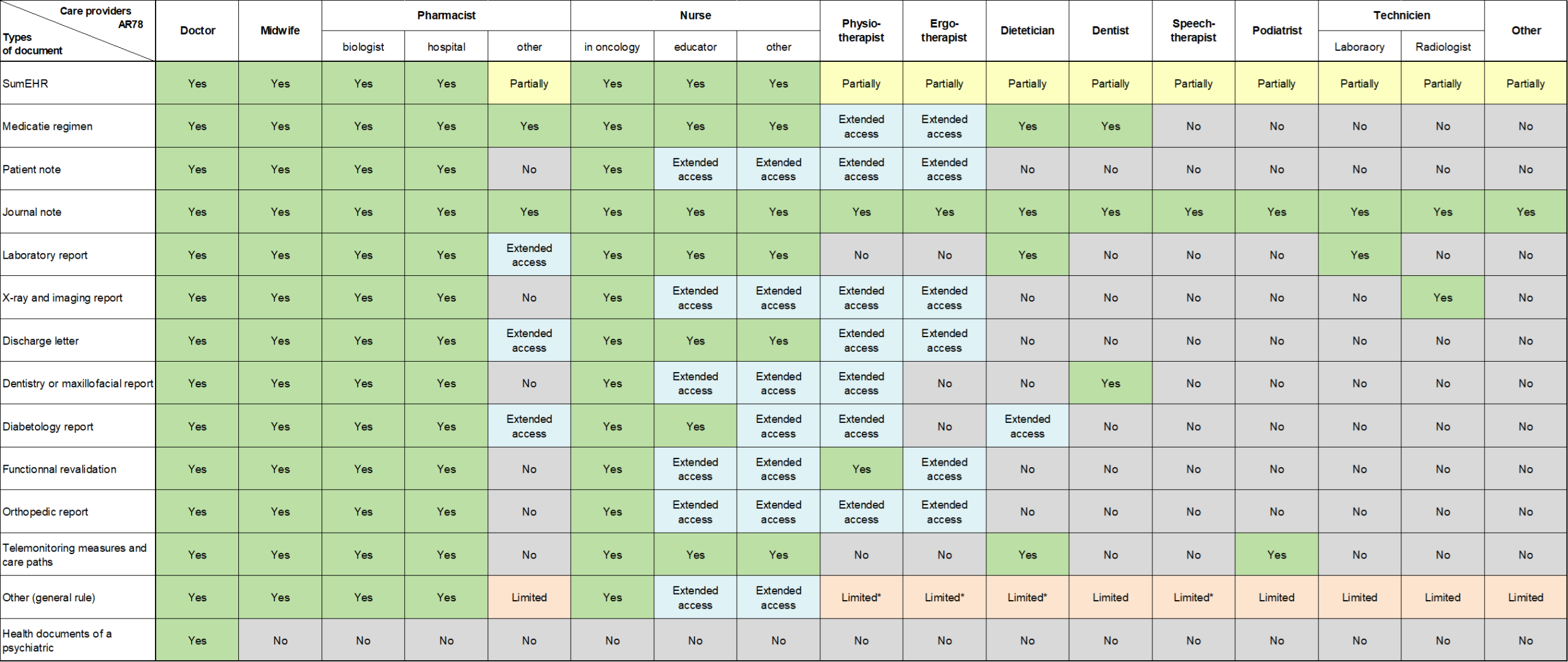
Légende du tableau
- Green “Yes” = Access.
- Grey “No” = No access.
- Yellow “Partially” = Detailed access in the matrix specific to SumEHR.
- Blue“Extended access”[1] = Extended access if explicit patient autorisation.[1]With the introduction of the concept of extended access rights, certain healthcare providers from the multidisciplinary sector (physiotherapists, dietitians, nurses, etc.) may now consult additional documents related to their field of expertise, provided that you have given your consent. For example, a physiotherapist may access orthopaedic reports, or a dietitian may access diabetology reports. These access rights enable more coherent and integrated care, while ensuring that only information relevant to their practice is accessible to them. You remain in control of your personal data and may manage these authorisations at any time via your personal space accessible on the Brussels Health Network portal.This extended access is therefore granted only with your explicit consent (except in emergency situations). In practical terms, the healthcare provider concerned submits a request via the Brussels Health Network. You will then receive an SMS notification containing either a link to approve the request or a four-digit code to be communicated to the healthcare provider concerned.
- Orange “Limited”
- “Limited” = Access limited to documents issued by a professional in th same category or explicity classified as belonging to that speciality (typically the data issued by the corresponding hospital departements). (For example : a dietician accesses data published by dieticians and documents published as relating to dietetics by hospitals).
- “Limited*” = This principle of transversal access “by profession” is extended to nurses, physiotherapists, occupational therapists, speech therapists and dieticians). Access means that nurses, physiotherapists, occupational therapists, speech therapists and dieticians can access documents in all 5 categories.This principle of transversal access “by profession” is extended to nurses, physiotherapists, occupational therapists, speech therapists and dieticians).
- Line “Other (general rule)” = Describes access rights that are not explicitly described by another line.
- Line “Patient note” = Any note made by the patient other tha, a diary note. This covers, in particular, the “Summary of health declared by the patient” and the “BeCoag” passport made available to haemophilia patients who so wish via the BeCoag portal.
6.2. Patients
Patients may manage access rights via their “private space”, as detailed in articles 7.4 and 7.7 below.
7. Patient
7.1. Informed consent from the patient for the sharing of his/her health data
Apart from the messaging flows currently managed through existing solutions, for data flows included in the secure technology of the Brussels Health Network, no sharing of data may take place before the patient has given his/her explicit and informed consent.
The patient’s informed consent for the sharing of their health data may be registered with the Brussels Health Network either by the patient themselves, or by a healthcare provider, a pharmacist, a nurse, a dentist, a hospital, or a health insurance fund with the patient’s consent.
Consent given by the patient for the sharing of data within the Health Network also applies for the federal portal at Myhealth.belgium.be. To be clear, the data published on the Brussels Health Network will also be accessible via the federal portal at Myhealth.belgium.be in compliance with the rules set out in these regulations.
Registration of consent can be made via various channels, including the federal portal at Myhealth.belgium.be or through one of the Belgian health networks (hub). As a hub, the Brussels Health Network is part of the policy of national consent registrations, using the means set out in the next point.
7.2. Registration of the patient on the secure Brussels Health Network platform
The patient becomes an active user of the Brussels Health Network when he/she registers with one of the hubs on the (federal) e-Health platform. This registration process includes the recording of the consent mentioned above, if it has not been given elsewhere.
The patient must be over 16 years of age to register with the Brussels Health Network and be able to access their shared health record. Before this age, registration is carried out by the legal representative.
This registration allows access to the private space on the Brussels Health Network website.
Registrations can be made:
- Directly by the patient on the website using his/her Belgian eID or via ITSME
- By any care provider with the patient’s consent
- By a care institution with the patient’s consent
- By the Brussels Health Network administrative office, based on written requests from patients, accompanied by a front/back copy of the patient’s identity card. In the case of legal representation, the request must be accompanied by a front/back copy of the legal representative’s identity card, as well as a document proving the identity of the patient represented and the status of the representative.
7.3. Revocation of the patient’s registration
The patient can revoke his/her registration at any time by withdrawing his or her consent in the same way as it was given ;
- either directly via his/her “private space” on the Brussels Health Network website
- or via his/her attending physician.
- or via the hospital
- or by sending a signed revocation request to the Data Protection Officer of the Brussels Health Network (dpo@abrumet.be). This request must be accompanied by a front/back copy of the identity card of the person making the request. Revocation only becomes effective when it has been processed by the Brussels Health Network.
The revocation of the registration implies that the patient will no longer have access to his or her “privacy space.”
7.4. Supervision of access rights by the patient
The way in which access rights are opened to care providers is set by these regulations.
Via his/her “private space” on the Brussels Health Network website, the patient can access the list of care providers who have accessed the patient’s records. Patients can also obtain this list, or more detailed information from the Data Protection Officer at the Brussels Health Network (dpo@abrumet.be) by sending a signed written request or electronically signed e-mail (e.g. via the electronic identity card) or by any equivalent signature, , accompanied by a front/back copy of the patient’s identity card or, if the patient is declared represented on the Brussels Health Network, his/her representative’s identity card.
The patient can block access to his/her data to one or more card providers, either directly via his/her “private space” on the Brussels Health Network website, or by sending a signed written request or electronically signed e-mail, accompanied by a front/back copy of the patient’s identity card or, if the patient is declared represented on the Brussels Health Network, his/her representative’s identity card to the Data Protection Officer (dpo@abrumet.be) of the Brussels Health Network. This action can also be taken, although only by the patient, using the federal e-healthConsent app. Exclusions of providers made at a federal level and at the level of the Brussels Health Network are synchronised.
In the same way, the patient can block the publication of one or more items of data relating to him/her by contacting the author of the document directly.
7.5. Access to his/her documents by the patient
Subject to the exceptions stated in the applicable legislation, including the Act of 22.08.2002 relative to patient rights and the special terms set by the health providers in the best interests of patients, the patient can access the contents of health data shared once it has been posted via the Brussels Health Network by the care providers who are the authors of that data.
Any care provider who is the author of the information can decide not to make all or part of the health data accessible to the patient, albeit while complying with the applicable legislation, including the Act of 22.08.2002 relative to patient rights and the GDPR.
7.5.1. Intervention by a person of trust
The patient can designate a person of trust of his/her choice, who will guide him/her or take his/her place for consulting the patient’s data shared via the Brussels Health Network. The identity of this person is recorded in the Brussels Health Network (an area is provided for this purpose in the patient’s details).
A person of trust can be registered with the Brussels Health Network
- either by the patient by entering the details of the person of trust’s identity card via the secure portal of the Brussels Health Network;
- or via a care institution or through the administrative manager of the Brussels Health Network based on a form signed by the patient and the person of trust. This request must be accompanied by a front/back copy of the identity card of either the patient or the patient’s person of trust.
7.5.2. Intervention by the patient’s legal representative
When a patient is not able to exercise his/her rights (as in the case of an underage person (minor) who is unable to fully understand his/her interests, or an adult who is unable to express what he/she wants, etc.), his/her legal representative (legal representative, representative designated by the patient, or representative designated pursuant to the Patient Rights Act, administrator acting for the person) will exercise his/her rights in accordance with articles 12 to 14 of the Patient Rights Act.
This representative, called the “Legal representative”, can be registered in the patient’s details in the Brussels Health Network. Any request for information must be made in the exclusive interests of the patient. The professional practitioner can refuse access to the patient’s data pursuant to protection of the patient’s privacy under article 15 of the Patient Rights Act.
Registration of the legal trustee with the Brussels Health Network can be carried out either via a hospital, or by the administrative manager at Abrumet, based on the form signed by the legal trustee and the supporting documents confirming this role.
7.5.2.1. Minor under 13 years of age
The legal representative has access to the shared file of a child under 13 registered with the Brussels Health Network and provided that he is declared as a representative of this child.
7.5.2.2. Minor over 13 and under 16 years of age
The legal representatives of children aged between 13 and 16 have access to the list of documents in the shared health record but cannot access the content of the documents themselves.
7.5.2.2. Minor over 16 years of age
From the age of 16, all access is deactivated for legal representatives. Access to the content may, however, be requested from the healthcare provider who produced the information (doctor, hospital, etc.) under the terms of the law of 22 August 2002 relating to the rights of the patient.
7.6. Rights set by the GDPR
Except where a legal provision in force in Belgium does not allow it, and subject to the relevant provisions of these regulations, the patient have the following rights under the GDPR for the processing operations for which ABRUMET is the controller:
- The right of access, including the right to know whether ABRUMET is processing your data;
- The right to have a copy of the data processed;
- The right to rectify the processed data;
- The right to object to the processed data;
- The right to restrict the processing of processed data;
- The right to the erasure of processed data;
- The right to the portability of processed data;
- The right to contact the DPO of ABRUMET (dpo@abrumet.be or 11 Rue de la Montagne, 1000 Brussels)
- The right to file a complaint with the Data Protection Authority: https://autoriteprotectiondonnees.be/citoyen
35 Rue de la Presse, 1000 Brussels
Tel.: +32 (0)2 274 48 00
Fax: +32 (0)2 274 48 35
E-mail: e: contact@apd-gba.be
Any request relative to the exercise of the rights of the person in question, as set by the GDPR for the processing carried out by ABRUMET in its capacity of data processor, must be sent to the data controller, i.e. the health provider. However and to enable the effective exercise of these rights, the request can also be sent to the Data Protection Officer of the Brussels Health Network (dpo@abrumet.be), who will pass the request on as soon as possible to the relevant data controller to follow up.
7.7. Private space
The Brussels Health Network gives the registered patient access to its “private space” application via its website. By using the “private space” application of the Brussels Health Network, the user fully and unconditionally accepts the privacy regulations and undertakes to comply with them. If the user refuses, he/she will be required to refrain from using the “private space” application of the Brussels Health Network.
Via his/her private space, the patient has access to the following functions detailed in these regulations:
- Revocation of the patient’s registration; (7.3)
- Rules for accessing data via the Brussels Health Network; (7.4,7.5 )
- Exclusion of a professional practitioner for accessing shared data; (7.4)
- Control of access to shared documents; (7.4, and 7.5)
- Access to the contents of shared data by the patient; (7.5)
- Registration of a person of trust and a representative (7.5.1. and 7.5.2)
7.7.1. Quality of information
The data available via the “private space” of the Brussels Health Network is deemed correct at the time of its publication by care providers, although it may have become inaccurate or out of date at the time the data is viewed. As a result, no guarantee can be given regarding the quality, accuracy or exhaustive nature of each item of information viewed in the “private space” application via the Brussels Health Network website.
The contents of the Brussels Health Network website and the “private space” application (including links) may be adjusted, modified or added to at any time without notice or communication.
7.7.2. Liability
The Brussels Health Network declines all liability for damage that may result from the use of information obtained through the “private space” application. This includes, without limitation, all indirect damage, losses, interruption to work, damage to programs or data on the IT system, hardware, software, etc. of the patient. It is the responsibility of the patient to take all precautions to ensure that what he/she selects for his/her use is free of any virus, worm, Trojan horse and other elements that may damage the patient’s data or hardware.
As a result, the patient is entirely responsible for any use that he/she makes of the information obtained via the “private space” application.
7.7.3. Links and redirections
The website and “private space” application contain hyperlinks to other websites, as well as redirections to other sources of information, such as other hubs. These links and sources of information are made available to the user on a purely indicative basis. The Brussels Health Network does not control these hyperlinks and other sources of information featured on these sites and is therefore unable to offer a guarantee of any kind as to the quality and/or exhaustive nature of this information. The Brussels Health Network declines all liability for any damage that may result from viewing the information contained on other or sources of information in general and to which the user is redirected by the “private space” application.
8. The care provider
8.1. Membership of the care provider
Only care providers who have agreed to this regulation and who and who are registered with the system may access the shared data and publish data.
The healthcare provider who does not carry out their professional activity within a hospital or who has a partial private (out-of-hospital) practice must:
- Either sign up on-line by visiting the Brussels Health Network portal (https://brusselshealthnetwork.be/professionnels-de-la-sante/je-minscris/comment-sinscrire/)
- Or complete the document in paper format available to download from the Brussels Health Network website, sign it and send it to the Brussels Health Network administration department.
- Or complete a registration form available on the Abrumet website, sign it electronically and send it by email to Abrumet (info@abrumet.be).
Automatically validated by the COBRHA database, the health provider will then be authorised to access the Brussels Health Network and its services.
For care providers working in a care institution, the Medical Officer
- Ensures that the data concerning the care provider that are communicated to the Brussels Health Network are accurate and up to date;
- Will manage the access of healthcare providers to the Brussels Health Network via the computerized patient file of his or her institution;
- Provide the care providers of his or her institution with adequate information about the present privacy regulations.
The institution itself will inform the Brussels Health Network of any change of Medical Officer.
8.2. Revocation of care providers
The administrators of Brussels Health Network can revoke a care provider in the event of this regulation being breached.
The care provider may make amendments to his/her/its details at any time.
By registering, the healthcare provider agrees to be notified by email of data breaches or significant changes to default settings. They also agree to receive Abrumet’s newsletter.
For care providers working in a care institution, this notification will be sent to the medical director for the institution.
8.3. Sharing data
Any care provider authorised to access the Brussels Health Network may decide whether or not to share data via the Brussels Health Network4. The care provider will ensure that only data required for the continuity of care and in line with his/her/its medical profile will be shared on the Network. It can also create extended access to specific documents for a care provider it recommends. The care provider will carry out this action as part of a confidentiality arrangement shared with the other care providers who themselves have undertaken only to access data in the very restrictive context of these regulations, in addition to the simple existence of a care-related or treatment relationship with the patient.
The sharing of data may be accompanied by access restrictions: any professional practitioner may, in agreement with the patient or his/her representative, either authorise or block access to this item of data to a specific list of care providers. The party sharing the data has the right to access this data insofar as he/she/it has a care-related or treatment relationship with the patient and where the patient has not blocked the care provider from accessing this data.
The informed consent of the patient applies to the sharing of both future and past data. Care providers remain free to publish the history of the file.
8.4. Viewing data
Any care provider with authorisation to access the Brussels Health Network may access the data posted on the Network on condition that he/she/it has a care-related or treatment relationship with the patient and where the patient has not blocked access to this item of data and/or this care provider.
Viewing data may only be within the very restrictive context of these regulations, in addition to the existence of a care-related or treatment relationship with the patient consultation.
The care-related or treatment relationship may be created by the care providers and/or by the patient. When a care professional refers his/her patient to another care professional, he/she may declare a treatment relationship between his/her patient and this other professional with the informed consent of his/her patient or at the request of this patient. This relationship expires after a certain period of time, defined for each type of relationship. The patient may always revoke it early.
In emergencies, the care-related or treatment relationship is assumed until proof is given to the contrary.
|
Type of authorisation |
Explanation |
Maximum lifetime |
|---|---|---|
|
Patient’s treating healthcare professional |
This type of link corresponds to the patient being cared for by a healthcare professional acting as the patient’s treating professional (typically a general practitioner but also, for example, a midwife in the case of home care). These types of link are specialised according to the category of healthcare professional (e.g. ‘general practitioner’). |
Fifteen months Exceptions :
N.B.: These exceptions were introduced by the 6 July 2021 amendment to deliberation no. 18/190 of the Information Security Committeean het Informatiebeveiligingscomité |
|
One-off outpatient treatment |
This type of link corresponds to one-off treatment of a patient by a specialist doctor outside the hospital. This type of link will typically be renewed in the event of a new contact. |
Three months |
|
One-off hospital treatment |
This type of link corresponds to one-off management of the patient by a care provider in an inpatient setting. This type of link will typically be renewed in the event of a new contact. These types of link are specialised according to the category of healthcare professional. |
Three months |
|
One-off emergency care |
This type of link corresponds to one-off emergency care provided by a doctor, for example, as part of an SMUR or on-call service, but also at the patient’s request. |
One month |
|
Dispensing of medicines in a pharmacy open to the public |
This type of link corresponds to the management of a patient’s pharmaceutical care within a pharmacy open to the public. This is the only type of link not declared at individual level in the BHN. |
Fifteen months |
|
Extended access granted by the patient |
These types of link are typically established in a context of multidisciplinary care. They correspond to patient management in a particular care context (such as, for example, diabetes monitoring). They are activated either by the patient (for example, by a positive response to an SMS), or by the patient’s GP in agreement with the patient. These links give healthcare professionals access to more data than is provided by default for their professional category. |
Two years |
9. Cancelling a reference to an item of data
Data or their reference can be deactivated in the event of an error or at the request of the patient by the professional who published this information.
The cancellation of a data reference may be carried out by the patient via their “private space” or via a request addressed to Abrumet.
10. Tracing access
Every action taken on an item of data is traced.
10.1. Viewing the overall trace of accesses
This is the list of care providers who have accessed the patient’s data. For each of them, the Brussels Health Network has a record of the days on which an access was recorded.
10.2. Viewing the detailed trace of accesses
This is the detailed list of all accesses to all data for a patient. For each access, ABRUMET has details of the identity of the person connecting, the exact time the data was viewed, the institution from which the call came and the identification of the document viewed.
11. Data Protection Officer
A Data Protection Officer has been designated by the Brussels Health Network, in line with articles 37 and following of the GDPR.
The DPO may be contacted for all questions or complaints relating to these regulations or for the exercise of their rights by data subjects.
However, for all requests that do not come under its remit, such as requests linked to the exercise of a right granted by the Patient Rights Act, the DPO may pass on the question or complaint to the data controller, which is the only party able to follow it up.
You can also lodge a request for mediation or a complaint to the Data Protection Authority (https://autoriteprotectiondonnees.be/citoyen).
Modified on 18/11/2026
- See the Regulations for sharing health data between health systems connected via the reference directory of the eHealth platform approved by the health section of the Sector-Specific Committee for social security and health in its deliberation nº 14/016 of 18 February 2014, amended on 9 June 2015. ↩︎
- See the Regulations for sharing health data between health systems connected via the reference directory of the eHealth platform approved by the health section of the Sector-Specific Committee for social security and health in its deliberation nº 14/016 of 18 February 2014, amended on 9 June 2015. ↩︎
- Note concerning COVID-19 vaccinations: these were recorded in Vaccinnet+. Historical data (prior to 6 January 2026) recorded in Vaccinnet+ and linked to Brussels-based vaccinators are transferred to the vault. From that date onwards, new records are entered via Vaccicard. ↩︎
- Sharing is only possible for patients who have given their consent to sharing in accordance with Article 7.1. ↩︎