
Data capabilities: building the foundations of tomorrow’s eHealth
You have probably already heard of “data capabilities”. But what exactly does this term encompass, and why is it so strategic for our healthcare ecosystem in Brussels and Belgium?
In short, data capabilities refer to the technologies, processes and standards that enable an organisation—or, on a larger scale, a data network—to collect, share and use health data efficiently, intelligently and securely.
It is not simply about “storing” data, but about making data actionable and accessible at the right time, in the right place and to the right healthcare professional.
The limitations of the current system
One of the major challenges in eHealth is interoperability. The current Hub-MetaHub system operates as a “Health Network”. Based on the KMEHR standard, it plays a vital role in sharing health data, but it has some notable limitations:
- Limited efficiency: PDF exchanges are slow.
- Lack of granularity: the data being shared are not sufficiently detailed.
- Limited interoperability: current technologies do not make full use of international standards.
Crucial information about a patient—such as laboratory results, discharge reports, medical history and medication—is often siloed across different systems that do not “speak” to one another, or do so in a suboptimal way.
FHIR
This is where new technological architectures come into play. To address these challenges, the global healthcare community is increasingly relying on modern standards, the best known of which is FHIR (Fast Healthcare Interoperability Resources). Think of FHIR as a “common language” that healthcare software systems can learn to speak in order to exchange information.
The aim is to provide a comprehensive and integrated solution that facilitates the exchange and standardisation of health data across multiple hospital institutions.
Abrumet’s role
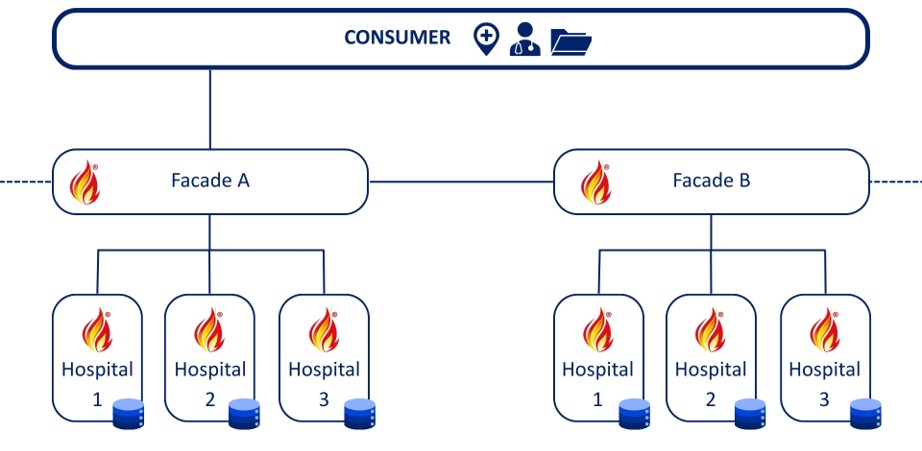
We are actively working to enable hospitals, GPs, mobile teams and all primary care stakeholders to collaborate effectively, supported by this new, robust interoperable infrastructure: a FHIR-based Data Network.
A connected ecosystem
The ambition is not to create one huge central database, but rather an interoperable and federated network. The future lies in mechanisms that make it possible to query different data sources—such as the FHIR servers of various hospitals or institutions—in a harmonised way. All of this, of course, while placing patient data security and confidentiality at the heart of the system.
By investing in these data capabilities, Abrumet and its partners are laying the foundations for better collaboration between institutions and for the sustainable improvement of care for every patient.